
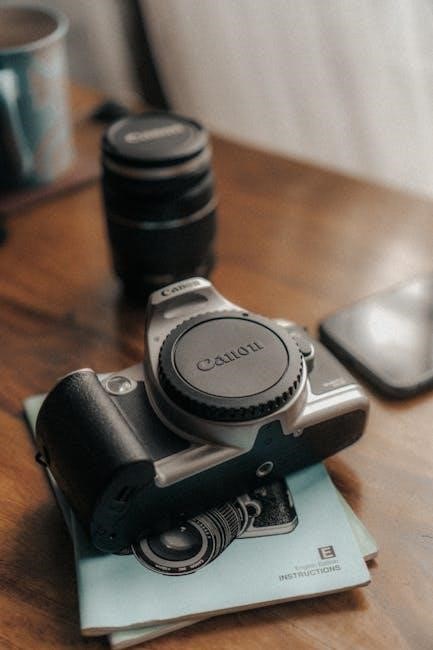
The Canon Rebel XSi (EOS 450D) is a 12.2-megapixel DSLR camera designed for entry-level photographers. Known for its compact design and user-friendly interface, it offers excellent image quality and versatility. The instruction manual provides essential guidance for mastering its features and settings, ensuring optimal performance for capturing stunning photos.
1.1 Key Features of the Canon Rebel XSi
The Canon Rebel XSi (EOS 450D) boasts a 12.2-megapixel CMOS sensor, delivering crisp, high-quality images. It features a 3-inch LCD screen with Live View, multiple shooting modes (Auto, P, Tv, Av, M, A-DEP), and compatibility with EF-S lenses. The camera also includes a self-cleaning sensor, EOS Integrated Cleaning System, and a comprehensive instruction manual for optimal functionality and customization.
1.2 Importance of the Instruction Manual
The instruction manual is essential for understanding the Canon Rebel XSi’s features and settings. It provides step-by-step guidance on optimizing camera performance, troubleshooting common issues, and exploring advanced functions. Reading the manual ensures users can fully utilize the camera’s capabilities, from basic operations to customizing settings for personalized photography experiences.

Unboxing and First Impressions
The Canon Rebel XSi comes with a camera body, EF-S 18-55mm lens, charger, strap, and manual, offering a comprehensive setup. Its lightweight design and intuitive controls leave a lasting first impression.
2.1 What’s Included in the Box
Unboxing the Canon Rebel XSi reveals the camera body, EF-S 18-55mm lens, LC-2 charger, neck strap, and user manual. Additional items like a software CD and quick start guide may also be included.
- Camera Body: The EOS 450D DSLR with 12.2MP sensor.
- EF-S 18-55mm Lens: A compact kit lens for everyday photography.
- LC-2 Charger: For charging the LP-E5 battery.
- Neck Strap: Durable and adjustable for comfortable carrying.
- User Manual: Detailed instructions for camera operation.
- Software CD: Includes EOS Utility and other tools.
2.2 Initial Setup and Camera Handling
Start by inserting the battery and charging it fully before first use. Attach the lens carefully, ensuring it clicks into place. Mount the lens by aligning the red dots on both the lens and camera. Set the date, time, and timezone in the menu. Use the neck strap for secure handling. Turn the camera on/off using the top dial. Always handle the camera with care to avoid damage.

Understanding the Camera Layout
The Canon Rebel XSi features a user-friendly design with top controls like the mode dial and shutter button, a rear LCD screen for navigation, and front lens controls for depth-of-field preview.
3.1 Top Controls: Mode Dial, Shutter Button, and Main Dial
The top controls of the Canon Rebel XSi include the mode dial for selecting shooting modes, the shutter button for capturing images, and the main dial for adjusting settings like aperture and shutter speed. These controls are ergonomically placed for easy access and intuitive operation, allowing photographers to quickly adjust settings without taking their eye off the viewfinder. The mode dial offers various options, including Auto, P, Tv, Av, M, and A-DEP modes, catering to different photographic needs. The shutter button is responsive, ensuring precise timing for capturing moments. The main dial provides tactile feedback, making it easy to fine-tune camera settings efficiently. Understanding these controls is essential for harnessing the camera’s full potential and achieving desired results in various shooting scenarios. By familiarizing yourself with their functions, you can streamline your workflow and focus more on creativity and composition.
3.2 Rear Controls: LCD Screen, Navigation Buttons, and Live View
The Canon Rebel XSi features a 3-inch LCD screen for image review and menu navigation. The rear controls include navigation buttons for accessing settings and functions. Live View mode allows composition directly on the LCD screen, offering precise focus control and enhanced shooting flexibility. These controls are intuitively designed, making it easy to adjust settings and review images efficiently.
This setup ensures a seamless and effective photography experience for all users.
3.3 Front and Side Controls: Lens Release, Depth-of-Field Preview, and More
The front includes the lens release button for easy lens changes and a depth-of-field preview button for reviewing focus. The side controls offer additional functionality, such as the AF-DRIVE button for adjusting autofocus and drive modes. These buttons enhance shooting flexibility and provide quick access to essential functions, ensuring efficient camera operation during photography sessions.
This design optimizes user experience and workflow.

Setting Up the Camera for the First Time
Insert the battery, memory card, and set basic preferences like language and date. Ensure firmware is updated for optimal performance and functionality from the start.
4.1 Basic Settings: Language, Date/Time, and Time Zone
Configure the camera’s language, date/time, and time zone to ensure accurate settings. These configurations are essential for proper camera operation and synchronization. Follow the manual’s step-by-step guide to set these preferences correctly. Accurate date/time settings are crucial for organizing and timestamping your photos. The manual provides clear instructions to help you navigate these initial configurations easily.
4.2 Firmware Updates: How to Check and Install the Latest Version
Regular firmware updates enhance performance and fix issues. To check for updates, connect your camera to a computer via USB or use a memory card. Visit Canon’s official website, download the latest firmware, and follow the installation instructions carefully. Ensure the camera is fully charged and avoid interruptions during the update process to prevent damage or malfunctions.

Basic Shooting Modes
Explore the Canon Rebel XSi’s basic shooting modes, including Auto, P, Tv, Av, M, and A-DEP, to suit various photography needs and skill levels effectively.
5.1 Auto Mode: Point-and-Shoot Simplicity
Auto Mode simplifies photography by automatically adjusting settings like aperture, shutter speed, ISO, and white balance. Ideal for beginners or quick shots, it delivers consistent results without manual adjustments, ensuring sharp, well-exposed images in various lighting conditions. This mode is perfect for capturing spontaneous moments with minimal effort, making it a great starting point for new users.
5.2 Creative Modes: P, Tv, Av, M, and A-DEP
Creative modes offer advanced control for personalized photography. Program (P) mode adjusts settings automatically but allows user tweaks. Shutter Priority (Tv) controls shutter speed for motion effects. Aperture Priority (Av) adjusts aperture for depth of field. Manual (M) mode enables full control over aperture and shutter speed. A-DEP optimizes focus across a scene, ensuring sharpness from foreground to background, ideal for group shots and landscapes.
Live View and Video Shooting
Live View enables previewing shots on the LCD screen for precise focus and composition. It also allows reviewing images immediately after capture. Video shooting offers basic recording capabilities, with frame rates and resolution options suitable for entry-level users, making it a great feature for capturing dynamic moments effortlessly.
6.1 Enabling and Using Live View
To enable Live View on the Canon Rebel XSi, press the dedicated Live View button. This feature allows you to preview your shot on the 3-inch LCD screen, aiding in precise focus and composition. Autofocus may be slower in Live View, but manual focus is also available for greater control over your images.
6.2 Basic Video Shooting and Settings
The Canon Rebel XSi allows for basic video recording in Movie Mode, accessible via the mode dial. Set resolution to 720p (1280×720 pixels) at 30fps for high-quality video. Use the LCD screen to frame your shots and adjust settings like white balance and exposure compensation before recording. Focus manually or use autofocus, and consider using an external microphone for better audio. Ensure memory cards have sufficient space for extended recording sessions.

Image Quality and Storage Settings
The Canon Rebel XSi features a 12.2 MP CMOS sensor, capturing images in JPEG and RAW formats. Store photos on SD/SDHC cards for optimal performance and organization.
7.1 Image Size and Quality: JPEG vs. RAW
The Canon Rebel XSi allows capturing images in JPEG or RAW formats. JPEG offers compressed files for convenience, while RAW retains full data for professional editing. Choose JPEG for ready-to-use photos or RAW for enhanced post-processing flexibility. Adjust image size via settings to balance quality and storage needs, ensuring optimal results for your photography style;
7.2 Memory Cards: Choosing the Right One and Formatting
Choose a compatible memory card, such as SD or SDHC, with sufficient storage capacity for your needs. Use high-speed cards for optimal performance. Format the card in-camera via the menu to ensure compatibility and proper function. Regular formatting helps maintain card performance and prevents data corruption. Always format in the camera, not on a computer, for best results.

White Balance and Picture Styles
White balance ensures accurate colors under various lighting. Presets like Auto, Daylight, and Tungsten simplify adjustments. Picture Styles enhance mood by modifying sharpness, contrast, and color tones for desired effects.
8.1 Understanding White Balance: Auto, Presets, and Custom
White balance adjusts colors based on lighting. Auto mode automatically detects settings, while presets like Daylight, Shade, Tungsten, and Fluorescent optimize for specific conditions. Custom white balance allows manual setup using a reference object, ensuring precise color accuracy. This feature is essential for capturing true-to-life hues and enhancing the visual appeal of your photographs in various environments.
8.2 Picture Styles: Standard, Portrait, Landscape, and More
Picture Styles optimize image settings like sharpness and contrast for specific subjects. Standard is versatile, Portrait enhances skin tones, Landscape emphasizes greens and blues, and Neutral offers minimal processing. Additional options like Faithful and Monochrome cater to creative needs. These styles are applied to JPEGs; for RAW files, settings are non-destructive, allowing post-processing flexibility.

Focusing Modes and Metering
The Canon Rebel XSi offers advanced focusing modes and metering options to ensure precise control over focus and exposure. Autofocus modes include One-Shot, AI Focus, and AI Servo, while metering options like Evaluative, Center-Weighted, and Partial provide accurate light measurement, helping you achieve sharp, well-exposed images effortlessly.
9.1 Autofocus Modes: One-Shot, AI Focus, and AI Servo
The Canon Rebel XSi features three distinct autofocus modes to cater to various shooting scenarios. One-Shot AF is ideal for stationary subjects, locking focus once the shutter is pressed. AI Focus AF automatically switches between One-Shot and AI Servo, making it suitable for unpredictable subjects. AI Servo AF continuously tracks moving subjects, ensuring sharp images even during rapid motion. Each mode offers precise control, enhancing your photography experience by capturing moments with accuracy and ease.
9.2 Metering Modes: Evaluative, Center-Weighted, and Partial
The Canon Rebel XSi offers three metering modes for precise light measurement. Evaluative Metering analyzes the entire scene for balanced exposure. Center-Weighted Average Metering prioritizes the center area, ideal for portraits. Partial Metering focuses on a small central spot, useful for high-contrast subjects. Each mode ensures accurate exposure control, adapting to various lighting conditions for optimal results in your photography.

Advanced Features and Customization
The Canon Rebel XSi offers advanced features like Custom Functions for personalization and A-DEP mode for depth control. Bulb mode enables long exposures, enhancing creative photography possibilities.
10.1 Custom Functions: Personalizing Your Camera
Custom Functions on the Canon Rebel XSi allow users to tailor camera settings to their preferences. Options include adjusting autofocus modes, metering systems, and flash settings. Personalizing these functions enhances shooting efficiency and ensures consistent results. The instruction manual provides a detailed guide to configuring each function for optimal performance.
10.2 A-DEP Mode and Depth-of-Field Preview
A-DEP mode on the Canon Rebel XSi helps achieve balanced depth of field by analyzing the scene and adjusting aperture and shutter speed. The Depth-of-Field Preview button allows users to visualize the area in focus before shooting. These features are essential for precise control over image sharpness and background blur, as explained in the instruction manual.
10.3 Bulb Mode for Long Exposure Photography
Bulb mode on the Canon Rebel XSi allows for extended exposures, controlled manually by the user. This feature is ideal for capturing light trails, starry skies, and other long-exposure effects. The instruction manual details how to use Bulb mode effectively, ensuring creative control over exposure duration for unique and artistic photography results with precision and ease.
The Canon Rebel XSi (EOS 450D) instruction manual provides comprehensive guidance for mastering its features. For further support, explore Canon’s official website, forums, and user communities for troubleshooting, firmware updates, and creative tips to enhance your photography experience with this versatile DSLR camera, ensuring optimal results and continued learning.
11.1 Troubleshooting Common Issues
Common issues with the Canon Rebel XSi include sensor cleaning, firmware updates, and error messages. Refer to the manual for solutions like resetting settings or updating firmware. For persistent problems, Canon’s support website offers detailed troubleshooting guides and access to service centers. Regularly cleaning the sensor and updating firmware can prevent many issues, ensuring smooth camera operation and optimal performance for capturing high-quality images.
11.2 Where to Find Additional Help and Tutorials
For further assistance, visit Canon’s official support website, which offers downloadable manuals, firmware updates, and software like EOS Utility. Additional tutorials and guides are available on Canon’s forums and third-party photography websites. Instructional videos and user communities provide hands-on learning and troubleshooting tips, ensuring you maximize your Canon Rebel XSi’s potential and improve your photography skills effectively.